Check the Receipts: Eby’s Pants Are Flamin’
Eby’s Record vs. Eby’s Rhetoric
Goodman Report
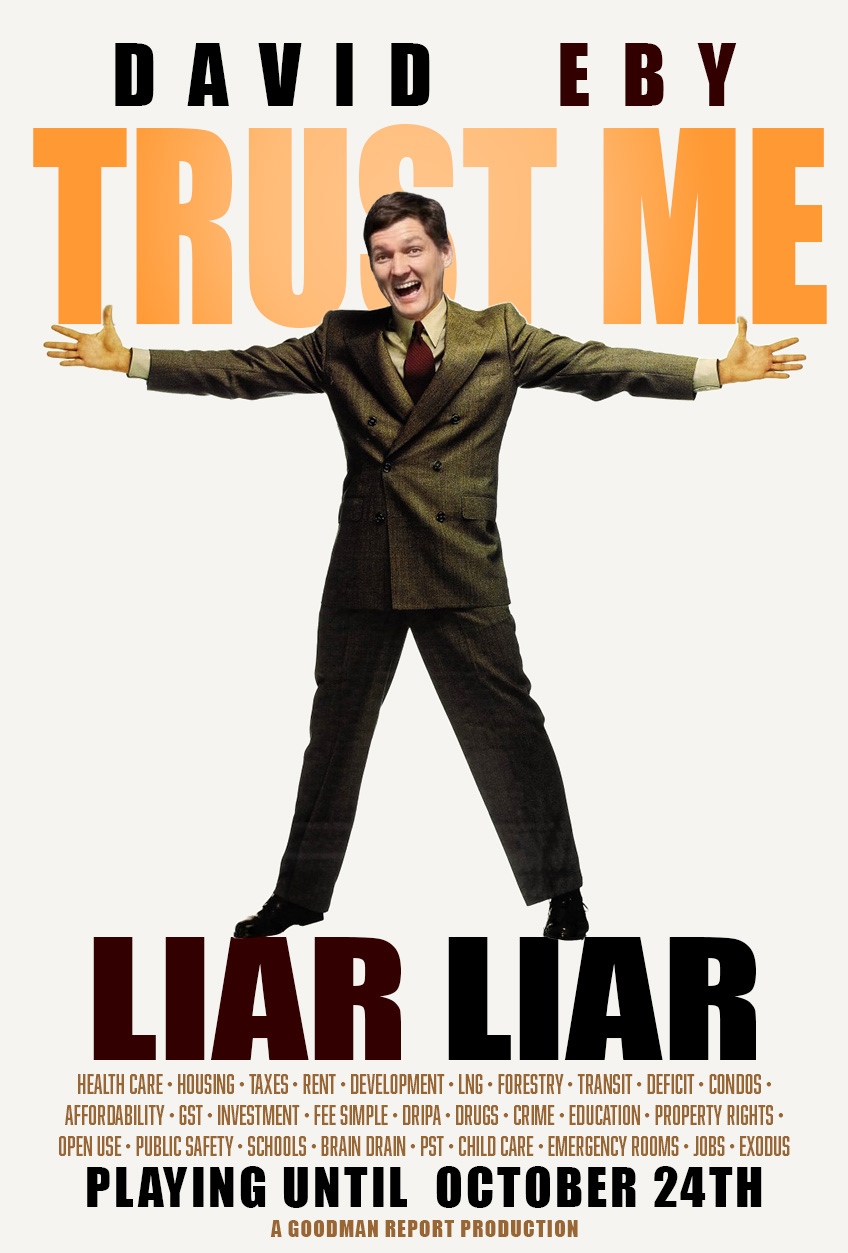
David Eby can’t be trusted.
By almost any measure, David Eby’s time leading the province has been a failure, and the gap between what he says and what he delivers has become the defining feature of his premiership. He has now called a snap election, two years early and with a majority in hand, to stand up to Donald Trump, he says, but his purported nemesis looks more like a role model: the same instinct to embellish, and the same confidence that voters won’t fact-check when he takes credit for achievements that either don’t exist or that he had nothing to do with.
The outgoing premier presents himself as the protector of health care, yet wait times continue to expand and emergency rooms keep closing for lack of staff. Cancelling the Burnaby Hospital expansion in April and reviving it the day before calling an election is about as on the nose as it gets in politics.
On economic issues, Eby has recast himself as a champion of resource development, after spending years resisting resource projects at every turn, from taking on the Trans Mountain pipeline expansion in court as Attorney General to presiding over a forest industry collapse that started long before Trump’s tariffs. The LNG industry, for which he now claims credit, rests on foundations laid by his BC Liberal predecessors. It took a ballooning deficit and sagging polls to make his hostility to industry untenable.
Nowhere is the gap between Eby’s rhetoric and his record wider than in housing.
On the campaign trail, the NDP leader now claims credit for falling rents and rising affordability, though neither traces to provincial policies. Rents and prices have eased: because Ottawa sharply cut immigration; because economic growth has stalled and job losses are mounting (not least in the housing sector itself); and because the market is awash in supply that was conceived and financed under entirely different conditions. When fewer people are competing for more homes, prices ease – that’s market economics, not a provincial policy achievement. Having benefited from a supply cycle he did nothing to create, Eby would have been wise to keep that supply flowing; instead, he seems intent on shutting it down.
The Transit-Oriented Areas policy, a key plank in Eby’s signature housing reforms, encapsulates it well. As with much of his government’s record, it amounts to a flashy news release with nothing behind it. Heavy-handed steamrolling of local governments with no regard for geography or neighbourhood context, it’s also toothless and ineffective. Municipalities quickly learned they could satisfy the requirements while adding poison pills that guarantee nothing gets built, and the province has shown little appetite for enforcing the spirit of its own policy.
The development financing overhaul follows the same script. The province scrapped Community Amenity Contributions, but handed cities a blank slate to raise fees far in excess of what they were charging in CACs. The province promised a mechanism to ensure projects remained viable after any new charges were introduced, but either that mechanism doesn’t exist or the analysis is being done as carelessly as most NDP accounting.
The condo buy-back program announced over the summer was poorly conceived and, beyond plumping up Eby’s record deficit, is unlikely to have a measurable effect. It also raises an obvious question: what happened to the shared equity pledge from the last election? It began as a partnership with the Musqueam, Squamish and Tsleil-Waututh Nations (MST) to advance their Heather Lands project, and was later expanded with great fanfare in the last campaign. Two years later, would-be buyers are still waiting to see any details.
Then we have taxes – and boy, do we have taxes! Eby has piled them up so steadily that it’s hard even to remember them all, and nearly all have names that mask what they actually do. Sold as a tool against speculators and foreign buyers, the Speculation and Vacancy Tax instead falls mostly on British Columbians who put their vacation money into a second home here rather than spending it overseas. The ever-rising Additional School Tax, which doesn’t fund schools. And the Flipping Tax, which treats a family that outgrows its home ahead of the government’s schedule the same as an investor chasing a quick profit.
And now the government wants to tax unsold condos, as if developers in an oversaturated market are hoarding units for fun. Builders will face another layer of uncertainty and another line item factored into the cost to build new homes, reducing the viability of new supply and raising the price floor for the few units that do move forward. The tax also discourages building on spec and selling to occupiers at completion, instead ensuring builders will only proceed once projects are fully presold. It pushes builders already on shaky ground further into the red.
Voters may have little sympathy for developers sitting on unsold inventory, but these are the same companies British Columbia will soon rely on to build the next wave of rental and affordable housing. The construction industry employs more British Columbians than forestry and mining combined, and pushing its builders out of business means fewer homes and less investment and economic activity in communities across the province. Imagine, for comparison, Ontario’s premier taxing automakers on unsold cars until they lose money on every vehicle they build and are forced to close their plants.
Yet this is what we have come to expect from a government that, only months ago, froze funding to non-profit housing providers and left roughly 4,000 affordable homes in jeopardy, many of them after years of work and millions of dollars spent preparing projects for a promised provincial funding program. It’s the same government that rejected a federal proposal to eliminate the GST on new homes, a tax that comes straight out of the buyer’s pocket, and that two-thirds of British Columbians say they want gone. A premier who claims to be on the side of affordability shouldn’t have to be talked into accepting help from Ottawa, and a government that adds a new tax every time a policy falls short shouldn’t be trusted with forming the next one.
There’s an old saying that you’re better off watching what politicians do than listening to what they say. Having seen Eby in action, you might take that under advisement.
Thank you for your attention to this matter!
(Authorized by Mark Goodman, registered sponsor under the Election Act, 604-558-5511)